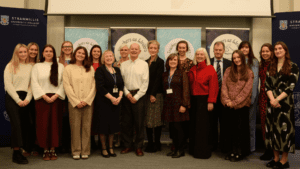
Stranmillis RE Specialists visit the Ecclesiastical Capital of Ireland

The 2nd Year RE Area of Specialism students and their tutors, Jill Magennis and Anita Gracie, hopped into a minibus on Wednesday morning, headed west along the M1 and hopped out again in Armagh City for a day visiting churches of the 4 main Christian denominations. Due to the long history of Christian worship and practice in Armagh, there are two cathedrals (both called St. Patrick’s) and several churches in easy walking distance of each other. The students visited St. Mark’s Church of Ireland, First Armagh Presbyterian, Armagh Methodist Church and St. Patrick’s Roman Catholic Cathedral.

One of the students reflecting on their day out commented: “It was an engaging and insightful practical experience where we learned so much about the history, traditions and practices of each denomination through guided tours and conversations with church leaders (with a quick coffee stop along the way, of course!). A very interesting and beneficial hands-on addition to our course”.

Year 3 BEd Students Gain Fresh Insight into Play-Based Learning at Stranmillis Primary

Last week, some of our BEd Primary Year 3 students had the wonderful opportunity to visit Stranmillis Primary School as part of their optional module ‘Learning through a Play-based Curriculum in the Early Years’.

During the visit, students heard from Foundation Stage teachers Miss Gowdy and Ms Finney as they shared how they implement continuous provision to support progression in learning through purposeful, play-based experiences.

Year 3 student Hannah McIntyre reflected:

Our visit to Stranmillis Primary School was such an enjoyable and inspiring experience! Stepping into the Primary 1 and 2 classrooms, I noticed how calm, welcoming and thoughtfully designed the learning spaces were. The continuous provision areas were beautifully set up to encourage independence, creativity and curiosity. My friends and I all came away feeling so inspired and full of ideas for our own future classrooms. The visit really reinforced for me how powerful play can be in creating joyful, meaningful learning experiences for young children’.

Jill Magennis would like to extend a sincere thank you to Principal Mrs Wilson, Miss Gowdy and Ms Finney for welcoming our students and sharing their expertise on how play is thoughtfully organised, supported and evaluated to enhance children’s learning and development. It was a valuable and uplifting experience that encouraged our students to reflect deeply on their own developing practice and the importance of play in early years education.


Exploring effective school leadership in disadvantaged communities: new podcast

A report recently published by Stranmillis University College’s Centre for Research in Educational Underachievement (CREU), Effective School Leadership in Disadvantaged Communities, has been featured on the podcast Education Matters.

Two of the report’s authors, Professor Noel Purdy OBE and Dr Emilia Symington, were invited by host Paul Hazzard to discuss their findings about what kinds of leadership can help schools thrive against the odds.

Funded by the James Kane Foundation and the Mary Ann McCracken Foundation, the study was inspired by the Independent Review of Education in Northern Ireland (2023) and set out to identify what makes schools in areas of high deprivation succeed. Analysing data from 190 schools, the Stranmillis research team — which also included Dr Mark Ballentine, Dr Karen Orr, Dr Glenda Walsh and Dr Katie Tate — identified 13 schools where pupils consistently achieved excellent GCSE results despite challenging circumstances.

Through in-depth interviews with principals, the team uncovered five key themes that underpin leadership success: Clarity of Vision, Championing Children, Connection, Character, and Continuation.

At the heart of their findings is a powerful message — that leadership grounded in values, relationships and belonging can overcome situational disadvantage.

Professor Purdy explained, “The most effective leaders understood that their vision needed to be owned by everyone — staff, pupils, parents and the wider community.”

Dr Symington added, “These leaders were relentlessly optimistic. They refused to define children by statistics.”

The research highlights the moral purpose and quiet strength of school leaders who lead with conviction, empathy and integrity. It also calls for greater investment in developing future leaders to ensure that this wealth of experience and wisdom continues to benefit schools in disadvantaged areas.

The episode of the Education Matters podcast can be viewed on YouTube above, or you can listen on Spotify here: https://shorturl.at/8Hf5p

You can read the report for yourself here, and watch the online research briefing here.


Centre of Digital Innovation and Technology (CDIT) Wins “Digital and Creative Excellence Award”

The Centre of Digital Innovation and Technology (CDIT), a pioneering collaborative framework, has been honoured with the “Digital and Creative Excellence Award” at the prestigious Belfast Chamber Business Awards.

CDIT is a multi-disciplinary partnership between Belfast Metropolitan College, Stranmillis University College, Queens University Belfast, and key industry partners. The Centre’s core mission is to advance digital innovation and technology through a skills-based approach, enabling industry and academia to co-create an educational experience for students built upon project-based learning.

The award recognises the dedication and impact of CDIT’s work in fostering industry-relevant skills and driving digital transformation.

Dr. Irene Bell expressed her delight at the win, stating, “We are thrilled that the dedication and hard work of CDIT has been recognised by the Belfast Chamber Business Awards. This honour validates the power of our collaborative model. It’s fantastic to see our innovative courses, such as the fully accredited qualification in ‘Mastering the Digital Classroom’ and the incredibly successful ‘Playful Computing Conference’, making a real difference in equipping initial teacher education students with essential digital skills.” This skills-based approach is not just about learning; it’s about enabling future leaders and professionals.

The CDIT framework provides a shared environment that ensures the education pipeline is directly aligned with the current and future needs of the digital economy. By placing students in a co-created, project-based setting, the partnership is successfully bridging the gap between academic theory and practical, real-world application.

This win reaffirms CDIT’s position as a leader in educational innovation and a crucial player in supporting the digital creative sector in Belfast and beyond.”


Celebrating Maths Week: The Power of Number Talk

As we celebrate Maths Week, it’s the perfect time to shine a spotlight on the importance of ‘number talk’ in early years education.

Evidence suggests that young children’s early experiences with number lay the foundations for later mathematical understanding, and that language plays a crucial role in this process.

Research consistently highlights the powerful link between talk and learning.

High-quality mathematical talk supports children’s ability to reason, make connections, and develop a deep understanding of key concepts. Klibanoff et al. (2006) found that the amount of mathematics-related talk used by teachers is significantly related to the growth of young children’s mathematical knowledge. In other words, when teachers actively use and model mathematical language, they help children build both confidence and competence in early mathematics. It is therefore vital that practitioners intentionally create opportunities to promote children’s understanding and use of mathematical vocabulary.

That’s why Dr Pamela Moffett (Stranmillis University College, Belfast), Dr Ann Marie Casserly, and Dr Bairbre Tiernan (St Angela’s College, Sligo) created Number Talk, a resource that was developed from a collaborative research project designed to support teachers in precisely this area. The book provides a practical framework for planning early number experiences with a particular focus on developing mathematical language.

The Number Talk resource offers a wealth of engaging, interactive activities that encourage children to explore number in meaningful contexts, through play, songs and rhymes, real-life situations, and structured experiences.

Many of the activities are multisensory in nature, inviting children to touch, see, hear, and move as they engage with mathematical ideas. Activities are suitable for both whole-class and small-group teaching and are easily adapted to different settings. The resource also emphasises the importance of a number-rich environment – one that surrounds children with opportunities to encounter, discuss, and apply number concepts in playful and purposeful ways. It provides practical suggestions for promoting number within both indoor and outdoor spaces, helping teachers make mathematics visible and accessible throughout the learning environment.

In addition, the resource includes ideas for engaging parents in supporting and enhancing children’s mathematical language development. By drawing on the mathematics inherent in daily life, children begin to see mathematics not as an isolated subject but as something that surrounds them every day.

Speaking about the resource, Dr Pamela Moffett comments “At the heart of Number Talk is the belief that mathematics is, above all, a talking subject. Encouraging children to verbalise their thinking, explain their reasoning, and use precise mathematical language deepens understanding and supports the development of early numeracy skills”.

The Number Talk resource can be purchased from the Stranmillis eshop here.

You can listen to Mrs Carole Anderson from Ballysally PS Coleraine relate her experience of using the resource here.

References
  • Klibanoff RS, Levine SC, Huttenlocher J, Vasilyeva M, Hedges LV. Preschool children’s mathematical knowledge: The effect of teacher “math talk.”. Dev Psychol. 2006 Jan;42(1):59-69. doi: 10.1037/0012-1649.42.1.59. PMID: 16420118.

‘Research for Change in Early Years Education’ brings together researchers, practitioners and policymakers at Stranmillis

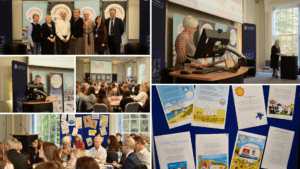
More than 70 educators, researchers, and policymakers came together at Stranmillis University College on Thursday, 11 September, for Research for Change in Early Years Education, a half-day event that showcased a selection of current research projects in early years education from across the island of Ireland. The gathering, held from 1:00 p.m. to 3:30 p.m., featured researchers from both Stranmillis University College, Belfast, and Atlantic Technological University (ATU) in the Republic of Ireland, combining presentations, discussions, and networking over lunch, with a focus on bridging the gap between research, policy, and practice.

The opening session, Systems, Structures, and Visions for Early Learning, set the tone for the afternoon. Presentations from Stranmillis staff included a review of the national ECCE programme in ROI by Dr Glenda Walsh, an exploration of communities of practice in early years placements from Catriona Rogers, and findings from a study on teachers’ perceptions of quality by Dr Andrea Doherty.

Building on this, the second session, Pedagogy, Play, and Children’s Voices, showcased further early years research from Stranmillis staff. Highlights included Dr Jill Dunn’s work on how digital tools can enhance writing engagement; Jill Magennis’s doctoral research on how peacebuilding pedagogies can support children in divided societies; and a joint presentation by Dr Glenda Walsh and Dr Andrea Doherty on reimagining playfulness in primary classrooms.

The final session, Creativity, Wellbeing, and Sustainability in Early Learning, featured speakers from ATU Galway/Mayo. Presentations included research on an Artist in Residence initiative for early childhood students (Mónica Muñoz Marín), a pilot programme on ocean literacy with young learners (Dr Rita Melia), and new approaches to supporting infant mental health (Dr Mary Skillington). These contributions underscored the role of creativity and wellbeing in building sustainable futures for children.

Speaking about the day, event organiser Dr Glenda Walsh, Head of Early Years and Doctoral Studies at Stranmillis University College, said, “We believe research can drive impactful change, and today’s conversations showed the power of bringing policy, practice, and research into dialogue”.

She added:

The early years are foundational. They shape not only children’s development but the fabric of our society. Events like this are critical in providing a platform for researchers to share their findings, connect with practitioners and policymakers, and ensure that evidence-based approaches influence real-world outcomes. The research we do must not sit on a shelf; it must be shared, challenged, and applied to shape the policies and practices that support our youngest citizens, in Northern Ireland and beyond.

“This event is just the beginning – we want to create an ongoing platform where research continues to inform practice and policy in meaningful ways,” Dr Walsh concluded.